Printed circuit board materials
Various requirements for printed circuit boards make the use of different circuit board substrates necessary.
Whereas for many standard applications the classical FR4 material is sufficient, possibly in high Tg version (for improved thermo-mechanical properties), for other areas (such as high frequencies) alternate materials are absolutely required.
The following information is intended as a abstract summary of all available material types and their fundamental properties, to make it easier for you to make a selection according to the required field of application.
The standard values of the processed materials can be found in following PDFs:
Material samples of the company Rogers can directly be requested here:
http://rogerscorp.force.com/samples/samples_public
On request, you can order circuit boards with EN 45545-2: 2013 certified material (fire protection requirements for rail vehicles) eg.g. from Isola: EN45545-2: 2013 Information.
Please note: The selected materials may be replaced by technically equivalent or similar products, according to available stocks on hand.
Materials for rigid circuit boards
| Material for rigid PCBs |  Tg Tg |  CTE-z CTE-z |  ?r ?r |  Dk Loss Tangent Dk Loss Tangent |  Electric strength Electric strength |  Surface resistivity Surface resistivity |  CTI CTI |  Td value Td value |  Peel strength Peel strength |
|---|
| Material for rigid PCBs | | Tg | °C | CTE-z | ppm/°C | ?r | @1GHz | Dk Loss Tangent | @1GHz | Electric strength | KV/mm | Surface resistivity | MO | CTI | PLC | Td value | °C | Peel strength | N/mm |
|---|
| Material for rigid PCBs | ISOLA Duraver DE104
Standard FR4 | Tg | 135° | CTE-z | 70 | ?r | 4,4 | Dk Loss Tangent | 0,020 | Electric strength | 54 | Surface resistivity | 1,0 x 10^6 | CTI | 2 | Td value | 315° | Peel strength | 1,6 |
|---|
| Material for rigid PCBs | Shengyi S1141
FR4 alternative | Tg | 140° | CTE-z | 65 | ?r | 4,6* | Dk Loss Tangent | 0,015* | Electric strength | 60 | Surface resistivity | 5,4 x 10^7 | CTI | 3 | Td value | 310° | Peel strength | 1,8 |
|---|
| Material for rigid PCBs | ISOLA Duraver DE104 KF
FR4 tracking resistant | Tg | 135° | CTE-z | 45 | ?r | 4,6 -
4,9 | Dk Loss Tangent | 0,020* | Electric strength | 39 | Surface resistivity | 1,0 x 10^6 | CTI | 1 | Td value | 315° | Peel strength | 1,6 |
|---|
| Material for rigid PCBs | ISOLA DE156
FR4 halogen-free | Tg | 155° | CTE-z | 45 | ?r | 4,0 | Dk Loss Tangent | 0,016 | Electric strength | 36 | Surface resistivity | 4,0 x 10^6 | CTI | - | Td value | 390° | Peel strength | 1,4 |
|---|
| Material for rigid PCBs | ISOLA IS400
FR4 MidTg | Tg | 150° | CTE-z | 50 | ?r | 4,0** | Dk Loss Tangent | 0,020 | Electric strength | 48 | Surface resistivity | 3,0 x 10^6 | CTI | 3 | Td value | 330° | Peel strength | 1,4 |
|---|
| Material for rigid PCBs | ITEQ IT-158
FR4 MidTg alternative | Tg | 155° | CTE-z | 60 | ?r | 4,3 | Dk Loss Tangent | 0,016 | Electric strength | 60 | Surface resistivity | 1,0 x 10^10 | CTI | - | Td value | 345° | Peel strength | 1,7 |
|---|
| Material for rigid PCBs | ITEQ IT-180A
FR4 HTg | Tg | 175° | CTE-z | 45 | ?r | 4,4 | Dk Loss Tangent | 0,015 | Electric strength | 45 | Surface resistivity | 3,0 x 10^10 | CTI | - | Td value | 345° | Peel strength | 1,4 |
|---|
| Material for rigid PCBs | Shengyi S1000-2
FR4 HTg alternative | Tg | 180° | CTE-z | 45 | ?r | 4,8* | Dk Loss Tangent | 0,013* | Electric strength | 63 | Surface resistivity | 7,9 x 10^7 | CTI | 3 | Td value | 345° | Peel strength | 1,4 |
|---|
| Material for rigid PCBs | ISOLA IS410
FR4 HTg, CAF-Enhanced | Tg | 180° | CTE-z | 55 | ?r | 4,0 | Dk Loss Tangent | 0,019 | Electric strength | 44 | Surface resistivity | 8,0 x 10^6 | CTI | 3 | Td value | 350° | Peel strength | 1,2 |
|---|
| Material for rigid PCBs | ISOLA IS420
FR4 HTg, CAF-Enhanced alt. | Tg | 170° | CTE-z | 45 | ?r | 4,0 | Dk Loss Tangent | 0,016 | Electric strength | 54 | Surface resistivity | 3,0 x 10^6 | CTI | 3 | Td value | 350° | Peel strength | 1,3 |
|---|
* at 1MHz, ** at 100MHz
Unless otherwise noted, the CTI (Comparative Tracking Index) which indicates the tracking resistance, is PLC3 (175V - 250V) for rigid PCBs. On request, we are also able to produce PCBs with PLC 2 (> 250V), PLC 1 (> 400V) or PLC 0 (> 600V). See Overview of CTI / PLC.
Materials for flexible circuit boards
| Material for flexible PCBs | 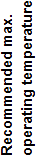 Max. recommended operating temperature Max. recommended operating temperature |  Copper type Copper type | Glass transition temperature Tg | εr | CTE-z | Electric strenght | Surface resistivity | Peel strength |
|---|
| Material for flexible PCBs | | Max. recommended operating temperature | °C | Copper type | * | Glass transition temperature Tg | °C | εr | @1MHz | CTE-z | ppm/°C | Electric strenght | KV/mm | Surface resistivity | MΩ | Peel strength | N/mm |
|---|
| Material for flexible PCBs | Polyimide + Adhesive | Max. recommended operating temperature | | Copper type | | Glass transition temperature Tg | | εr | | CTE-z | | Electric strenght | | Surface resistivity | | Peel strength | |
|---|
| Material for flexible PCBs | Shengyi SF305 | Max. recommended operating temperature | 105° | Copper type | RA | Glass transition temperature Tg | - | εr | 3,6 | CTE-z | - | Electric strenght | 21 | Surface resistivity | 1 x 10^5 | Peel strength | 1,1 |
|---|
| Material for flexible PCBs | Polyimide Adhesiveless | Max. recommended operating temperature | | Copper type | | Glass transition temperature Tg | | εr | | CTE-z | | Electric strenght | | Surface resistivity | | Peel strength | |
|---|
| Material for flexible PCBs | DuPont Pyralux AP | Max. recommended operating temperature | 180° | Copper type | RA | Glass transition temperature Tg | 220 | εr | 3,4 | CTE-z | 25 | Electric strenght | 256 | Surface resistivity | 1 x 10^10 | Peel strength | 1,8 |
|---|
| Material for flexible PCBs | Panasonic RF775 | Max. recommended operating temperature | 130° | Copper type | ED | Glass transition temperature Tg | 343 | εr | 3,2 | CTE-z | - | Electric strenght | 276 | Surface resistivity | 1 x 10^8 | Peel strength | 1,7 |
|---|
| Material for flexible PCBs | Thinflex W-05050 | Max. recommended operating temperature | 105° | Copper type | ED | Glass transition temperature Tg | 350 | εr | 3,3 | CTE-z | 24 | Electric strenght | 216 | Surface resistivity | 1 x 10^5 | Peel strength | 0,6 |
|---|
| Material for flexible PCBs | PI Coverlay | Max. recommended operating temperature | | Copper type | | Glass transition temperature Tg | | εr | | CTE-z | | Electric strenght | | Surface resistivity | | Peel strength | |
|---|
| Material for flexible PCBs | Shengyi SF305C | Max. recommended operating temperature | 105° | Copper type | - | Glass transition temperature Tg | - | εr | - | CTE-z | - | Electric strenght | - | Surface resistivity | 3 x 10^6 | Peel strength | - |
|---|
| Material for flexible PCBs | DuPont Pyralux FR | Max. recommended operating temperature | 180° | Copper type | - | Glass transition temperature Tg | - | εr | 3,5 | CTE-z | - | Electric strenght | 138 | Surface resistivity | 1 x 10^7 | Peel strength | - |
|---|
| Material for flexible PCBs | Adhesive tape | Max. recommended operating temperature | | Copper type | | Glass transition temperature Tg | | εr | | CTE-z | | Electric strenght | | Surface resistivity | | Peel strength | |
|---|
| Material for flexible PCBs | 3M 9077 | Max. recommended operating temperature | 150° | Copper type | - | Glass transition temperature Tg | - | εr | - | CTE-z | - | Electric strenght | - | Surface resistivity | - | Peel strength | - |
|---|
* RA = Rolled copper, suitable for dynamic, flexible applications; ED = Electrolytically deposited copper , only suited for stable and semi-dynamic applications (see Design-Aid Flex boards)
Materials for metal core boards
Material for high frequency boards
| Material for high frequency boards |  Order share Order share | ?r | Dk Loss Tangent | Tg | Td value |  Thermal conductivity Thermal conductivity | CTE-z | Electric strenght | Surface resistivity | Peel strength |
|---|
| Material for high frequency boards | | Order share | | ?r | @10GHz | Dk Loss Tangent | @10GHz | Tg | °C | Td value | °C | Thermal conductivity | W/m*K | CTE-z | ppm/°C | Electric strenght | kV/mm | Surface resistivity | MO | Peel strength | N/mm |
|---|
| Material for high frequency boards | Rogers 4350B
HF material | Order share | +++ | ?r | 3,5 | Dk Loss Tangent | 0,0037 | Tg | 280° | Td value | 390° | Thermal conductivity | 0,69 | CTE-z | 32 | Electric strenght | 31 | Surface resistivity | 5,7 x 10^9 | Peel strength | 0,9 |
|---|
| Material for high frequency boards | Rogers 4003C
HF material | Order share | ++ | ?r | 3,4 | Dk Loss Tangent | 0,0027 | Tg | 280° | Td value | 425° | Thermal conductivity | 0,71 | CTE-z | 46 | Electric strenght | 31 | Surface resistivity | 4,2 x 10^9 | Peel strength | 1,1 |
|---|
| Material for high frequency boards | Panasonic Megtron6
HF material | Order share | + | ?r | 3,6 | Dk Loss Tangent | 0,004 | Tg | 185° | Td value | 410° | Thermal conductivity | - | CTE-z | 45 | Electric strenght | - | Surface resistivity | 1 x 10^8 | Peel strength | 0,8 |
|---|
| Material for high frequency boards | Rogers RO3003
PTFE ceramic-filled | Order share | + | ?r | 3 | Dk Loss Tangent | 0,0013 | Tg | - | Td value | 500° | Thermal conductivity | 0,5 | CTE-z | 25 | Electric strenght | - | Surface resistivity | 1 x 10^7 | Peel strength | 2,2 |
|---|
| Material for high frequency boards | Rogers RO3006
PTFE ceramic-filled | Order share | o | ?r | 6,2 | Dk Loss Tangent | 0,002 | Tg | - | Td value | 500° | Thermal conductivity | 0,79 | CTE-z | 24 | Electric strenght | - | Surface resistivity | 1 x 10^5 | Peel strength | 1,2 |
|---|
| Material for high frequency boards | Rogers RO3010
PTFE ceramic-filled | Order share | o | ?r | 10 | Dk Loss Tangent | 0,0022 | Tg | - | Td value | 500° | Thermal conductivity | 0,95 | CTE-z | 16 | Electric strenght | - | Surface resistivity | 1 x 10^5 | Peel strength | 1,6 |
|---|
| Material for high frequency boards | Taconic RF-35
Ceramic | Order share | o | ?r | 3,5* | Dk Loss Tangent | 0,0018* | Tg | 315° | Td value | - | Thermal conductivity | 0,24 | CTE-z | 64 | Electric strenght | - | Surface resistivity | 1,5 x 10^8 | Peel strength | 1,8 |
|---|
| Material for high frequency boards | Taconic TLX
PTFE | Order share | o | ?r | 2,5 | Dk Loss Tangent | 0,0019 | Tg | - | Td value | - | Thermal conductivity | 0,19 | CTE-z | 135 | Electric strenght | - | Surface resistivity | 1 x 10^7 | Peel strength | 2,1 |
|---|
| Material for high frequency boards | Rogers RO3001
Bonding Film for PTFE | Order share | - | ?r | 2,3 | Dk Loss Tangent | 0,003 | Tg | 160° | Td value | - | Thermal conductivity | 0,22 | CTE-z | - | Electric strenght | 98 | Surface resistivity | 1 x 10^9 | Peel strength | 2,1 |
|---|
| Material for high frequency boards | Taconic TLC
PTFE | Order share | - | ?r | 3,2 | Dk Loss Tangent | - | Tg | - | Td value | - | Thermal conductivity | 0,24 | CTE-z | 70 | Electric strenght | - | Surface resistivity | 1 x 10^7 | Peel strength | 2,1 |
|---|
Material for high-Tg circuit boards (selection)
| Material for High-Tg boards | Tg | CTE-z | ?r | Electric strenght | Surface resistivity | CTI | Thermal conductivity | Td value | Peel strength |
|---|
| Material for High-Tg boards | | Tg | °C | CTE-z | ppm/°C | ?r | @1GHz | Electric strenght | KV/mm | Surface resistivity | MO | CTI | PLC | Thermal conductivity | W/m*K | Td value | °C | Peel strength | N/mm |
|---|
| Material for High-Tg boards | ISOLA IS410
FR4 HTg, CAF-Enhanced | Tg | 180° | CTE-z | 55 | ?r | 4,0 | Electric strenght | 44 | Surface resistivity | 8,0 x 10^6 | CTI | 3 | Thermal conductivity | 0,5 | Td value | 350° | Peel strength | 1,2 |
|---|
| Material for High-Tg boards | ISOLA IS420
FR4 HTg, CAF-Enhanced | Tg | 170° | CTE-z | 45 | ?r | 4,0 | Electric strenght | 54 | Surface resistivity | 3,0 x 10^6 | CTI | 3 | Thermal conductivity | 0,4 | Td value | 350° | Peel strength | 1,3 |
|---|
| Material for High-Tg boards | ITEQ IT-180A
FR4 HTg | Tg | 175° | CTE-z | 45 | ?r | 4,4 | Electric strenght | 45 | Surface resistivity | 3,0 x 10^10 | CTI | - | Thermal conductivity | - | Td value | 345° | Peel strength | 1,4 |
|---|
| Material for High-Tg boards | Shengyi S1000-2
FR4 HTg | Tg | 180° | CTE-z | 45 | ?r | 4,8* | Electric strenght | 63 | Surface resistivity | 7,9 x 10^7 | CTI | 3 | Thermal conductivity | - | Td value | 345° | Peel strength | 1,4 |
|---|
| Material for High-Tg boards | ARLON 85N
Polyimid HTg | Tg | 250° | CTE-z | 55 | ?r | 4,20* | Electric strenght | 57 | Surface resistivity | 1,6 x 10^9 | CTI | - | Thermal conductivity | 0,2 | Td value | 387° | Peel strength | 1,2 |
|---|
CAF - Conductive Anodic Filament: an undesirable conducting filament in the substrate of a circuit board