

For PCBs that are exposed to high thermal loads, it is important to determine the required maximum operating temperature (MOT) in good time in order to determine a suitable material.
The maximum operating temperature is the temperature at which a PCB can be operated continuously without suffering damage. The Tg value / Td value of the base material can be used as a reference for this.
Below we have summarized the details for you.
Tg Value
The glass transition temperature (Tg) is an important normative dimension for the base material that determines the temperature at which the resin matrix converts from a glassy, brittle condition into a soft, elastic one.
The Tg value of the base material sets here an upper boundary, at which the resin matrix decomposes and a subsequent delamination occurs. The Tg is thus not the value of the maximum operational temperature, but rather that which the material can endure for only a very short time.
A guideline for a continuous thermal load is an operating temperature approximately 25°C below the Tg.
When the glass transition temperature (Tg) is over 170°C, it is referred to as a high Tg material.
High Tg materials have the following properties:
- High glass flow temperature value (Tg)
- High temperature durability
- Long delamination durability
- Low Z axis expansion (CTE-z)
CAF - Conductive Anodic Filament: an undesirable conducting filament in the substrate of a circuit board
CTE-z
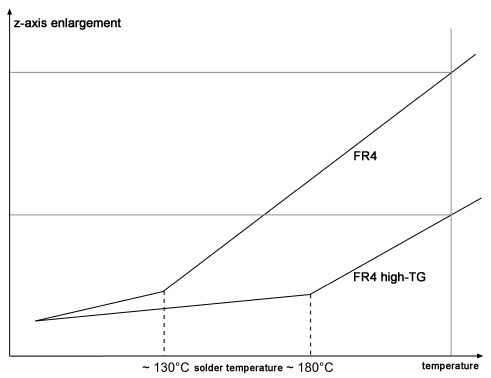
The CTE value shows the thermal expansion of the base material. CTE-z represents the z-axis and is e.g. due to the stability of the vias, of high importance. A higher Tg value favors a low CTE-z value which represents the absolute expansion in the z-axis.
The expansion of PCB materials occurs volumetrically when the temperature increases, whereby the laminate structure is designed in such a way that the expansion in the x-y plane and along the z-axis is significantly different.
The restrictive glass fabric contained in the laminate prevents isotropic expansion of the resin (uniform expansion in all directions), so that the expansion in the x and y directions is significantly lower than in the z direction.
Errors like pad lifting, corner cracks and cracks within the via can be prevented through a low CTE-z value.
T260 - T288 value, Td
The decomposition temperature Td of a resin system depends on the binding energies within the polymers, and not on the glass transition temperature Tg. A good indicator for this characteristic is the T260 or T288 value, which specifies the time until delamination at 260°C or 288°C, respectively.
A very important indicator of the heat resistance is the time-to-delamination at a certain temperature. This test is preferably performed at 260 °C or 288 °C. The T260- or T288-value is the time to delamination of the tested material at 260 °C or 288 °C, repectively.
Td: Temperature-of-decomposition indicates the temperature at which the base material has lost 5% by weight and is an important parameter for the thermal stability of a base material. Through exceeding this temperature an irreversible degradation and damage to the material by the decomposition occurs.
High-Tg printed circuit boards FAQ
The Tg value (glass transition temperature) is the temperature at which the base material changes from a glassy-brittle to a soft-elastic state. From a Tg of 170 °C, we speak of high-Tg material. This value is significantly higher than that of standard FR4 (approx. 130-140 °C).
No. The Tg value is not a permanently permissible application temperature. If it is exceeded, the resin matrix will decompose and delamination may occur. The following applies as a guideline for continuous operation: Application temperature approx. 25°C below the Tg value. At Tg 170°C, this means a maximum continuous operating temperature of approx. 145°C.
The CTE-z value describes the thermal expansion in the thickness (z-axis). A low CTE-z value - as is usual with high-Tg PCBs - is crucial for the reliability of the vias under thermal stress. It prevents typical faults such as pad lifting (lifting of the contact surfaces), sleeve cracks in the vias and corner cracks (cracks at corners) - especially with repeated temperature changes.
Yes, indirectly. CAF (Conductive Anodic Filament) refers to the unwanted growth of conductive filaments along glass fibres. Many high-Tg materials (such as ISOLA IS410 or 370HR) are explicitly CAF-enhanced, meaning they resist this effect better. This is particularly important for fine structures and high humidity under tension.
A high-Tg material is always required if your PCB is repeatedly exposed to high temperatures during operation or production. Typical indications are Ambient temperatures above 120°C continuously, lead-free soldering processes with high peak temperatures or applications with strong temperature changes (e.g. in automotive electronics or power electronics). In case of uncertainty, early consultation with our CAM team will help.