

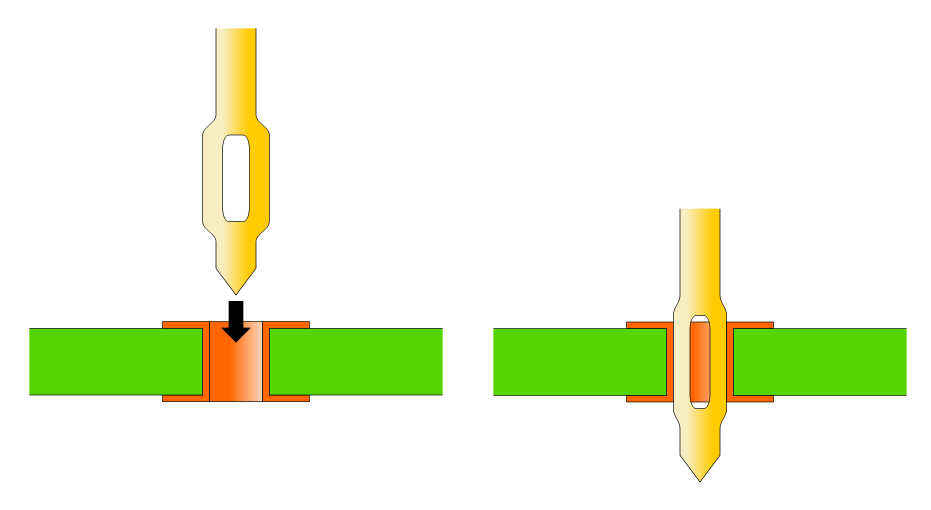
Press-fit technology is a solder-free electrical-mechanical connection technology between component and circuit board. For this purpose, a press-fit pin is pressed into the through-hole plating of the circuit board. At the contact points between the pin and the hole wall, gas-tight zones are created by cold welding the contact materials.
As an alternative to THT or SMT soldering, the press-fit technology helps to avoid thermal stress and ensures a high level of reliability of the connection and (in the solid pin version) a high current carrying capacity.
Press-fit technology requires a low tolerance of the hole diameter and is therefore special production.
You should define an extra layer for press-fit technology and output this as an extra drilling program at Gerber export. ODB++ data contain the information automatically! If you would like to use our data import service (e.g. for EAGLE, KiCad, ...) please inform us of the relevant layer.
Advantages of press-fit technology:
- High reliability of the connection with extremely low FIT value (Failure in Time)
- No thermal stress on the connection components thanks to solderless assembly
- High holding forces: pins make gas-tight contact in the metallized drill holes
- Efficient assembly process: press-in process using a toggle lever or pneumatic press
For press-fit technology, please send us the manufacturer's data sheet together with your circuit board data and activate the "press-fit technology" option in our circuit board calculator. Press-fit should be defined in an extra layer. A tinned surface finish is recommended for gold-plated pins (e.g. chemical tin, HAL lead-free).
Surfaces for press-fit technology
Press-fit technology can basically be produced with all end surfaces. Due to the low tolerance, our customers typically choose a chemical surface, e.g. chem. Gold (recommended) or chem. Tin. HAL lead-free (hot air solder levelling) is an alternative. The surface may already be specified directly by the connector manufacturer.
It is not recommended to combine gold-plated pins with chemical gold surface, as this can lead to increased press-in forces. Either pin or circuit board surface should be tinned. Only then, there is sufficient slippage during the press-in process.
Press-fit Parameters
| Tolerance | on Request | min. distance to SMD | |
|---|---|---|---|
| Final diameter Ø ≤ 6.0mm (drilled) | ±0.05 | +0.1mm/-0mm | 2mm |
| Final diameter Ø > 6.0mm (milled) | ±0.075 | ±0.05 | 2mm |
From a final diameter of approx. 6.0mm (depending on the surface) the holes are milled, not drilled.
Please indicate the final diameter in your design and send us the manufacturer's data sheet with your order.
Please ensure a minimum distance of 2mm to neighbouring SMD components in order to avoid critical mechanical loads when assembling.
Press-fit technology FAQ
There are two main types of press-fit pins for the press-fit technique:
Flex zone pins (with a compliant, elastic area) deform during press-fit and are gentle on the hole wall, ideal for multilayer and frequent repairs.
Solid pins are rigid and achieve very high retention forces, which makes them ideal for current-carrying connections and applications with high mechanical requirements. The choice depends on the application, current carrying capacity and the manufacturer's specifications.
In principle, all common FR4 materials are suitable. High dimensional accuracy and a good glass transition temperature are important - see high-Tg PCBs - as the material is subjected to punctual stress during press-fitting.
One advantage of press-fit technology is that it is easy to repair. In contrast to soldered connections, press-fit pins can often be pressed out again using special tools. Particularly when using flex zone pins, multiple cycles (pressing in and out) are usually possible, whereas solid pins are designed for permanent, one-off assembly.
The press-in force is the decisive quality indicator in the joining process. It is not a fixed value, but the force progression is monitored over the press-fit path (force-path monitoring). This makes it possible to recognise whether the pin is seated correctly, whether the hole wall is damaged or whether there are tolerance problems.
Quality assurance is carried out in several stages. The press-in force is often monitored non-destructively during the process (force-displacement monitoring). Destructive push-out tests can quantitatively test the holding force. Microscopic micrographs provide information about the gas tightness and the deformation of the pin and hole wall on the inside.
Two international standards in particular set the standard for press-fit technology:
- IEC 60352-5: This is the most important standard for solderless electrical connections - Part 5: Press-fit connections. It defines requirements, test methods and application guidelines.
- DIN EN 60652-5: The German adoption of the IEC standard.
In addition, connector manufacturers such as ERNI, TE Connectivity or HARTING often specify their own detailed design rules and tolerance specifications for their specific press-fit zones, which are usually based on these standards or concretise them.
Yes, this is possible and is used in the automotive industry, for example, to attach connectors directly to the rigid section of a rigid-flex PCB. Particular care must be taken in the transition area between the rigid and flexible zones, as mechanical stresses can occur here. The press-fit process should therefore not take place too close to this area.
A gas-tight connection is created by cold welding the contact materials at the microscopically small contact points between the pin and the hole wall. During press-fitting, the surfaces are pressed together under high pressure to such an extent that they deform and the air-filled cavities disappear. As a result, the contact zone is completely sealed off from the ambient air.
The big advantage: without oxygen and moisture, no corrosion (oxidation) can occur at the critical contact point. The connection remains stable for decades and maintains a constantly low contact resistance - this is the basis for the high reliability (low FIT values).
Press-fit technology is favoured wherever maximum reliability is required and thermal loads must be avoided. Typical areas of application are
- Automotive & commercial vehicle electronics: Solderless and vibration-resistant connections are indispensable, especially in demanding environments such as engine control units, airbag systems or the high-voltage battery technology of electric cars.
- Industrial & medical technology: The gas-tight contacts, which are stable against environmental influences in the long term, as well as the repairability of high-quality assemblies are valued here.
- Aerospace and railway technology: Extreme mechanical loads and large temperature fluctuations are commonplace in these areas. The high holding forces and resistance of press-fit technology are decisive advantages here.
- Power supply and renewable energies: In high-current applications, such as those found in telecommunications, in converters for wind turbines or in power electronics, solid press-fit pins are often used for a secure and low-resistance connection.